
In this article 9 sections
The short version
- Create a repeatable review request workflow using SMS, email, QR codes, or post-service follow-up.
- Respond promptly to positive, neutral, and negative reviews instead of treating reviews only as damage control.
- Audit ratings, review velocity, recurring complaints, listings, and brand mentions each month.
Why Review Management Matters More Than Ever
In 2026, your online reputation is your most powerful marketing asset.
When customers search for your business, they see star ratings, number of reviews, recent review activity, owner responses, and AI-generated summaries. Before they visit your website, they judge your credibility.
Platforms like Google, Yelp, and Facebook heavily influence buying decisions. Your review profile determines whether customers click or scroll.
The Revenue Impact of Online Reviews
Small businesses with 4.5+ star ratings, 50+ recent reviews, consistent responses, and steady review velocity see higher click-through rates, call volume, booking rates, and walk-in traffic.
A 0.5-star increase can significantly impact revenue. Review management is one of the highest ROI growth strategies available.
Reputation Management Is Bigger Than Reviews
Reputation management includes Google reviews, Yelp reviews, Facebook comments, Reddit discussions, local directories, AI search summaries, and voice assistant responses.
Your brand sentiment across the internet shapes trust. If negative reviews go unanswered, that becomes your narrative. If customers consistently praise you, that compounds.
AI Search Is Reshaping Small Business Visibility
Customers now ask AI platforms questions such as: Who is the best dentist near me? Is this business reliable? Top-rated med spa in Chicago?
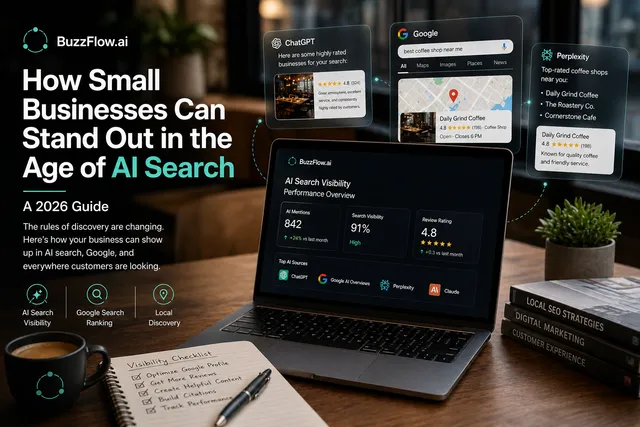
AI-powered platforms like ChatGPT, Perplexity AI, Google AI Overviews, Microsoft Copilot, and Anthropic Claude generate answers based on reviews, rating averages, review frequency, website content, brand mentions, and sentiment signals.
You are no longer just optimizing for Google rankings. You are optimizing for AI interpretation.
Generative Search Optimization (GSO) for Small Businesses
Generative Search Optimization (GSO) focuses on optimizing your digital presence for AI summaries and conversational search queries.
Instead of short keyword searches, customers now ask detailed questions. AI systems evaluate reputation strength, recency of reviews, engagement levels, content quality, and authority signals.
Your reputation data feeds AI answers.
The 5-Pillar Review & AI Reputation System
-
Automated Review Generation: Use SMS requests, email follow-ups, QR codes, and post-service automation to increase review volume.
-
24–72 Hour Response Rule: Respond to positive, neutral, and negative reviews promptly.
-
Review Response Templates and AI Prompts: Use structured templates for different review types and leverage AI tools for consistency.
-
Monthly Reputation Audit: Track average rating, review velocity, recurring complaints, and competitor comparisons.
-
AI Visibility Optimization: Encourage detailed reviews, maintain high ratings, ensure consistent business information, publish FAQ content, and monitor brand mentions.
Common Reputation Mistakes Small Businesses Make
Common mistakes include only responding to bad reviews, buying fake reviews, ignoring outdated listings, failing to request reviews consistently, and treating reputation management as damage control instead of a system.
Industries That Benefit Most
Restaurants, dentists, medical practices, home services, gyms, law firms, agencies, and local retail businesses benefit significantly from strong review and reputation management strategies.
The Competitive Advantage in 2026
The businesses winning today rank well on Google, maintain strong review velocity, respond consistently, are summarized positively by AI platforms, and show trust signals across the ecosystem.
Reputation management is now ecosystem-wide. It is no longer just about star ratings; it is about AI visibility.